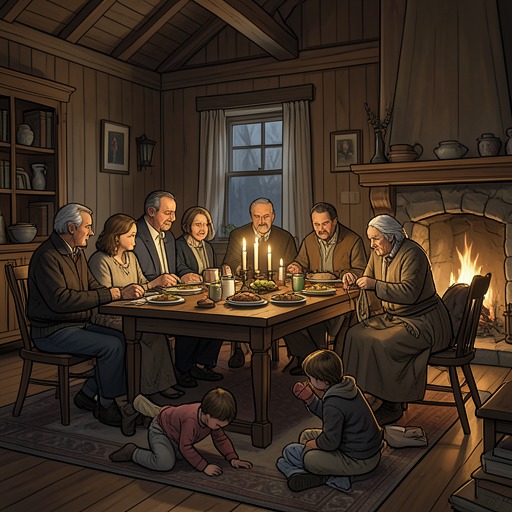
Rostov family's evacuation of wounded soldiers from Moscow
War and PeaceThe Rostov family's evacuation of wounded soldiers from Moscow marks the moment when private property and social convention yield to immediate human need. As Moscow faces abandonment, the family initially prepares its carts for household goods, but Natasha Rostova recognizes that the wounded soldiers outside their home have a more urgent claim. Her intervention redirects the family's departure and turns evacuation into an act of collective care.
Setting and Immediate Crisis
The episode unfolds during Moscow's last days before the city's occupation. The Rostovs are preparing to leave, while wounded soldiers and officers are being moved through the threatened city. One wounded man is brought into the Rostovs' house and placed in the wing, in the room that had belonged to Madame Schoss, because he cannot safely be carried upstairs. The family is therefore confronted not with an abstract patriotic question but with visibly injured men whose survival depends on transport and shelter.
The practical crisis is sharpened by the shortage of carts. The household's vehicles have been loaded with trunks and valuables, and the family must decide whether its possessions will be carried away while wounded soldiers are left behind. This conflict places evacuation, normally understood as the preservation of one's household, against a broader obligation to preserve life. The choice is made under the pressure of imminent military occupation, not in the calm conditions of charitable deliberation.
Natasha Rostova's Intervention
The decisive turn comes when Natasha learns that Count Ilya Rostov has considered giving the carts to the wounded. She reacts with anger and shame at the suggestion that the family might carry away its belongings while injured men remain in Moscow. Her emotional response is immediate and bodily: she rushes upstairs, confronts her mother, and insists that the arrangement is intolerable. The scene presents her outrage as a recognition that the family's ordinary priorities have become morally distorted by the emergency.
Countess Natalya Rostova initially hesitates, but Natasha's protest forces the issue into the open. The countess then tells Count Ilya Rostov to do what is right, and he accepts the decision with tears of joy. Natasha asks to supervise the change herself. The household's moral reversal is thus also a reversal of authority: a young woman who had not been directing the evacuation becomes the person who gives it a humane purpose, while her parents formally confirm the order.
Reorganizing the Evacuation
The servants do not immediately believe Natasha's strange order. Only when Count Ilya Rostov confirms it in his wife's name do they begin unloading the carts and placing the wounded inside them. Objects packed for removal—china, bronzes, pictures, and mirrors—are taken out and left in the yard or moved into storage. The material cost is concrete: the family's carefully prepared possessions are sacrificed piece by piece so that more men can be transported.
The rescue rapidly expands beyond the immediate household. Wounded soldiers emerge from their rooms and gather around the carts, their pale faces becoming hopeful when they hear that vehicles are available. News spreads to neighboring houses, and injured men begin arriving at the Rostovs' yard. The evacuation therefore becomes a collective operation rather than a single act of family generosity. The steward identifies additional places, Countess Natalya Rostova offers her wardrobe cart, and even the carriage intended for her own use is considered for the wounded.
The work acquires its own momentum. Once the unloading begins, the family discovers that the distinction between essential and nonessential property has lost its former force: if another cart or another space can be found, another injured man can be saved. Servants who had accepted the removal of goods as the obvious course now find the rescue equally obvious. Their zeal suggests that moral action is not imposed on the household from outside; once the first decision is made, it reorganizes everyone's perception of what the emergency requires.
Consequences and Significance
The action changes the value of the Rostovs' departure. They still intend to leave Moscow, but they no longer treat evacuation as the protection of family wealth alone. Their carts become instruments for carrying vulnerable people out of danger, and the household's possessions become expendable in comparison with the lives before them. The event's decisive value shift is from self-preservation through property to shared survival through sacrifice.
Natasha experiences the change with rapturous excitement, an intensity she has not felt for a long time. Her excitement does not arise from victory or possession but from discovering a form of action in which feeling, judgment, and practical labor coincide. The family follows her lead, yet the scene avoids presenting compassion as a purely private sentiment: it depends on carts, servants, storage space, drivers, and rapid coordination. Humanitarian conduct is made real through material decisions.
Placed against the wider French invasion of Russia, the episode gives a domestic scale to the novel's account of war. Armies are repeatedly constrained by boots, food, roads, hospitals, horses, and transport; the Rostovs' rescue reveals the same logistical reality within a household. Wounded men cannot be saved by sympathy alone. They require vehicles that might otherwise carry china, pictures, mirrors, trunks, and wardrobes. The family's decision therefore joins moral transformation to the practical infrastructure of survival.
The episode also contrasts with the surrounding destruction of Moscow. The city is being emptied, occupied, looted, and burned, while the Rostov household converts its limited resources into a temporary network of care. Its significance lies not in grand command but in a change of attention: the wounded, previously treated as an obstacle to orderly departure, become the central human fact around which the departure must be organized. The evacuation makes compassion visible as a collective, material, and consequential form of wartime action.